
During the process of assisting enterprises in deploying Intercom, we actively collect and summarize user feedback. Among them, one of the most frequently asked questions is whether the system can support seamless integration with other applications to reduce data redundancy and achieve cross-platform collaboration.
When a customer service system cannot support cross-application integration, agents often have to switch back and forth between multiple systems, making operations cumbersome and error-prone. This significantly increases response time and sharply reduces customer satisfaction. Meanwhile, corporate data becomes fragmented across different independent applications, making it difficult to consolidate and analyze. As a result, businesses cannot fully understand customer needs and behaviors, hindering precise marketing strategy formulation. Over time, this affects overall operational efficiency and weakens business competitiveness.
Next, this article will explore which applications Intercom can integrate with seamlessly, helping you understand how these integrations can optimize customer engagement experiences and leverage tool synergy to drive business growth.
Customer Pain Points
In the digital marketing industry, companies that fail to integrate their customer service systems with other applications often face the following issues. When users make inquiries via an ad landing page, the customer service system is disconnected from the CRM, preventing agents from viewing browsing history or previous conversations. As a result, they must repeatedly ask customers for information, lowering service efficiency and causing frustration. Additionally, when the customer service system is not connected to marketing automation tools, customer interest cannot automatically trigger follow-up actions such as email marketing.
This not only leads to poor customer communication experiences and potential client loss but also reduces the ROI of advertising campaigns. Companies struggle to access complete customer data, making it difficult to optimize marketing strategies effectively, which ultimately affects business growth in a competitive market.
Say Goodbye to Customer Service Challenges — Intercom Supports Seamless Integration with Multiple Applications
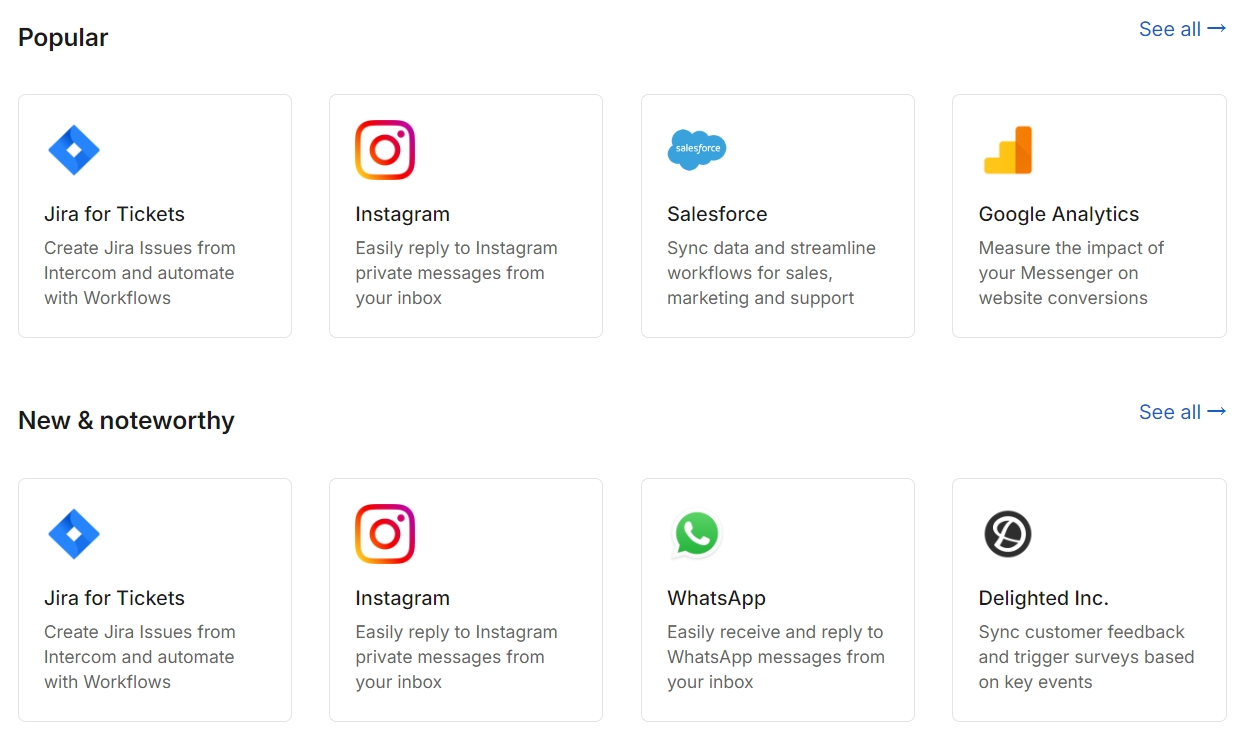
To meet the diverse business needs of enterprises, Intercom supports seamless integration with more than 450 applications, including major platforms such as Salesforce, Facebook, WhatsApp, HubSpot, and Zendesk. This powerful integration capability helps companies break down data silos, enabling seamless circulation of customer information, conversation records, and business data. As a result, team collaboration efficiency and customer experience improve significantly, while providing enterprises with more comprehensive data insights.
View Intercom’s supported application integrations:
https://www.intercom.com/app-store/
01. Salesforce
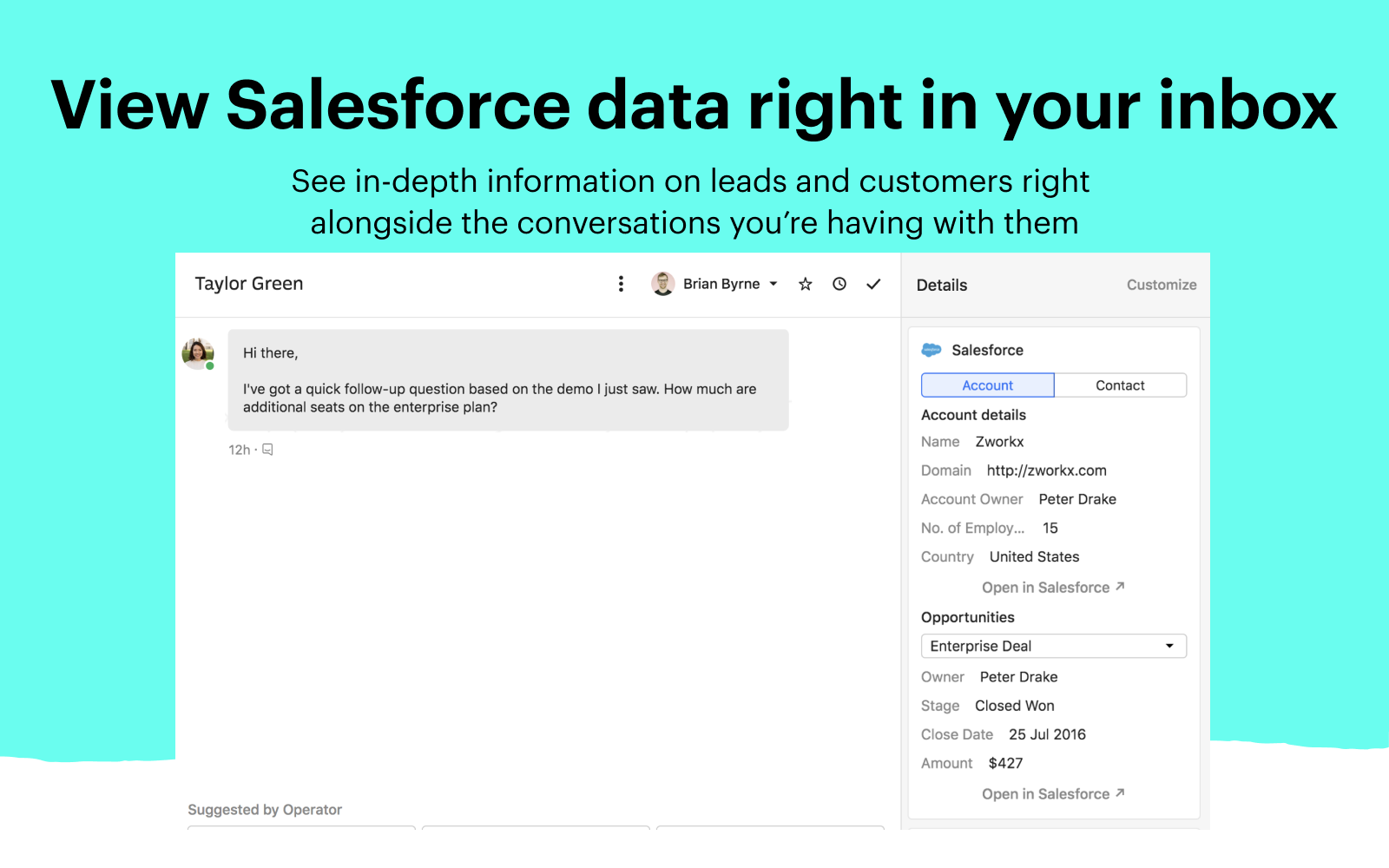
By seamlessly connecting Salesforce with Intercom, your marketing team can use Salesforce data to launch targeted outbound campaigns and automatically create new leads in Salesforce after capturing prospects from your website. Your sales and support teams can gain a full understanding of leads by viewing both Salesforce insights and Intercom conversations, and automatically route chats to the right team members. The Salesforce app in Intercom enables your team to:
- Automatically create new leads in Salesforce when Intercom captures new prospects and syncs their data and conversations, ensuring your CRM is always up to date.
- Automatically assign prospects and existing customers to their account owners or the right sales/support teams to ensure faster routing and response times.
- View Salesforce data directly within the Intercom Inbox, minimizing the need to switch between apps — including lead status, owner, key contacts, contact details, opportunity stage and value, and expected close date.
- Use Salesforce data to segment and target outbound messages more precisely, ensuring marketing campaigns reach the right audience.
02. WhatsApp
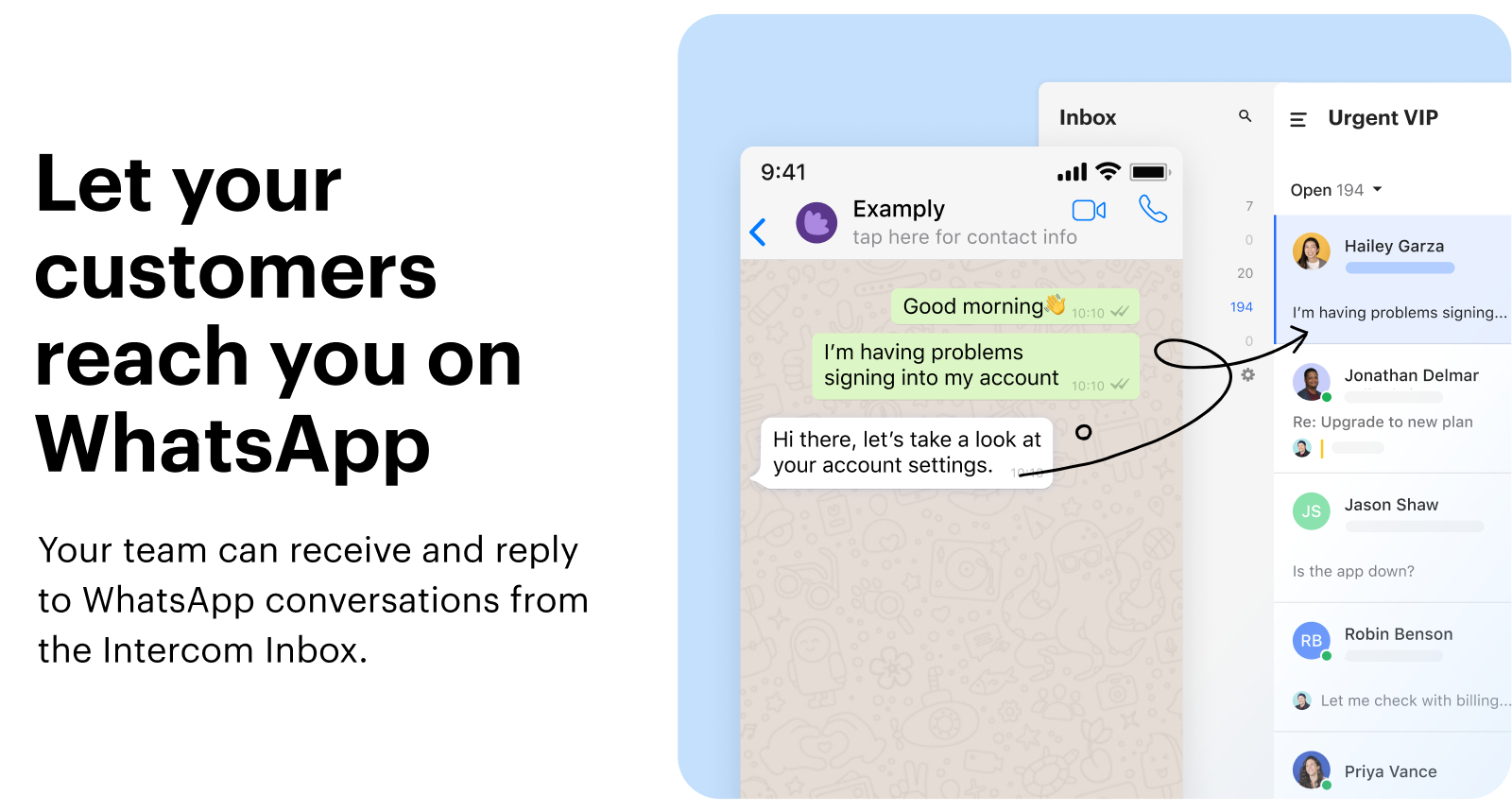
Import private WhatsApp messages directly into your Intercom Inbox to manage all customer conversations in one place. This provides customers with the convenience they expect while maintaining your team’s efficiency and reporting accuracy.
- Customers can easily start a chat through your designated phone number, message link, or QR code.
- Your team can manage WhatsApp conversations efficiently within Intercom using familiar workflows and tools.
- If customers leave your website or app, they can choose WhatsApp as their preferred channel to continue the conversation.
- WhatsApp conversation data is included in custom reports and CSV exports, allowing you to evaluate cross-channel support interactions and analyze WhatsApp-specific results to optimize your omnichannel customer service strategy.
03. HubSpot
Keep HubSpot information up to date in real time and view key HubSpot data about leads and customers directly from your Intercom Inbox. This integration allows you to:
- Automatically sync new leads and qualification data you collect, ensuring HubSpot information is always current.
- Automatically log lead conversations from Intercom into HubSpot activity records, providing a complete view of every interaction.
- Access HubSpot data directly from the Intercom Inbox (such as emails, company information, pipeline stage, and lead owner) to keep full visibility into each contact.
- Automatically align lead ownership information between HubSpot and Intercom.

Powered by AI — Intercom Ushers in a New Era of Customer Service
As an innovation leader in the customer service field, Intercom simplifies enterprise workflows through seamless cross-application integration. These integrations allow teams to manage data from different applications within a single platform, enhancing productivity and collaboration. At the same time, they help customer service teams gain a more comprehensive understanding of customers, enabling more personalized and effective support.
